
Key Points
-
The RBA left the cash rate on hold at 4.35% for the second meeting in a row. Some softer than expected readings for underlying inflation, jobs and home prices allowed it to remain in wait and see mode as it “assesses” the impact of the three rate hikes earlier this year.
-
However, the RBA retained a tightening bias noting that inflation Is “still too high” and is likely to remain so for “some time” and that it will do what it considers necessary to bring inflation back to target, “including increasing the cash rate further”, but with no reference to cutting.
-
We expect a further rate hike in November because underlying inflation is likely to take too long to fall to target and the RBA will need to do more to boost its credibility.
-
The post meeting statement had 16 references to inflation and just 2 references to the labour market – which reinforces where the RBA’s concerns are at present.

The RBA remains in wait and assess mode
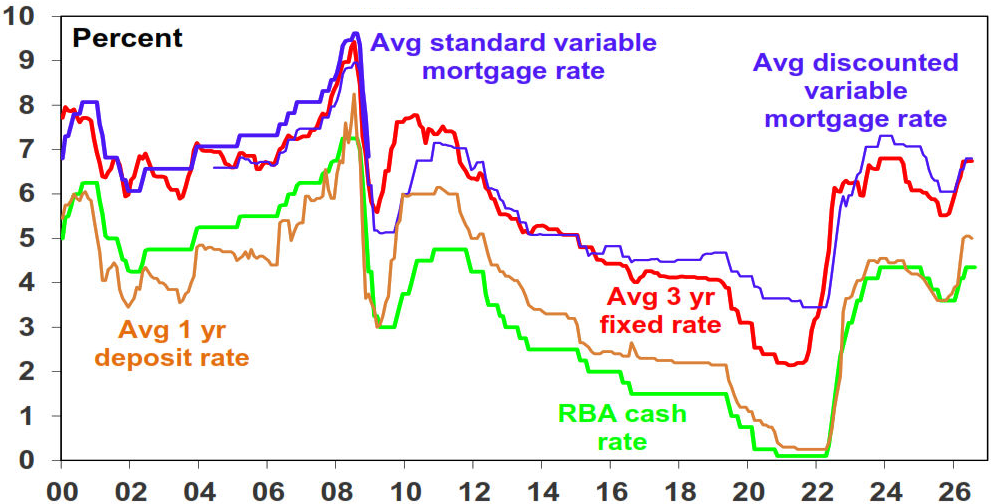
The RBA’s decision to leave rates on hold at 4.35% was no surprise. This followed a decision to leave rates on hold in June after three consecutive rate hikes earlier this year.
Australian Interest rates
 Source: Bloomberg, AMP
The RBA revised down its near-term inflation forecasts
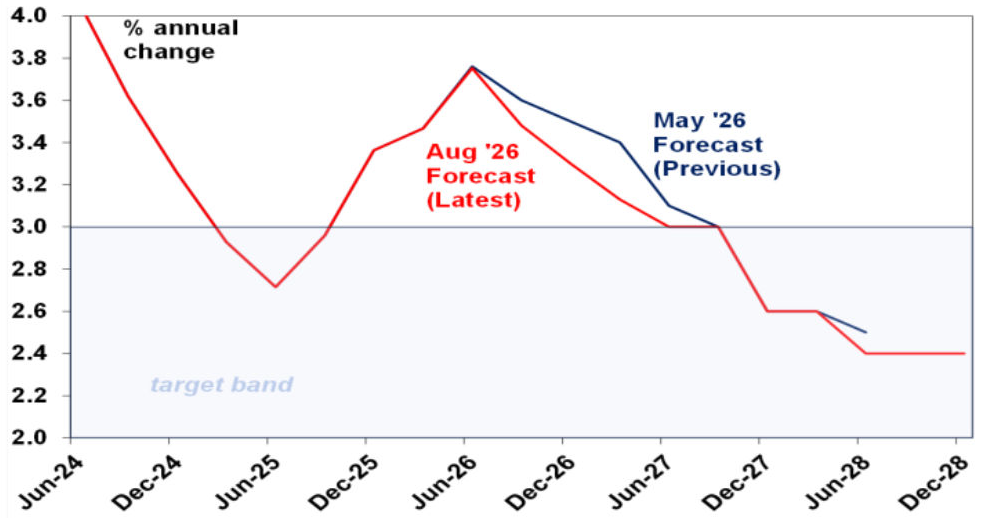
The RBA revised slightly down its near-term forecasts for trimmed mean or underlying inflation, largely reflecting a lower-than-expected outcome in the June quarter (3.6%yoy versus 3.8%). However, it still doesn’t see trimmed man inflation getting back to around the 2.5% target until late next year and notes that there are “upside risks to this projection”. And the forecast growth inflation trade off remains very poor with a slump in growth to around half of the historic norm of 3%yoy and higher unemployment required to bring inflation back to target. This in large part reflects ongoing poor productivity growth which means that the pace at which the economy can grow without generating above target inflation is now a lot lower than it used to be.
RBA’s Trimmed Mean Inflation Forecast
 Source: RBA SOMP, AMP
Why the RBA left rates on hold
In leaving rates on hold again, the RBA noted signs that the economy is slowing and that it was appropriate to leave rates on hold as it continues to assess the lagged response to the three rate hikes this year and how the economy is evolving. In this regard it noted that financial conditions have tightened, there are signs that growth in consumer spending is slowing gradually, labour market conditions have cooled more than expected and house prices have eased more than assumed.
Against this though, the RBA noted that business investment is strong, the labour market is still judged to be “a little tight”, capacity constraints remain, some firms are passing on cost increases and inflation remains too high and is likely to remain so for some time and that its inflation forecasts face upside risks.
All of which continues to suggest that while the RBA remains in wait and assess mode, its primary concern remains excessive inflation. This was again highlighted in the RBA’s post meeting Statement where it noted that it “it will do what it considers necessary to bring inflation sustainably back to target, including increasing the cash rate further if upside risks [to inflation] materialise.” And Governor Bullock’s press conference left no doubt that the RBA is hawkish, noting that the Board “will raise rates further if required” and she said that “personally, I think it’s quite possible we might need to [hike further].” While the June meeting considered only a “hold”, this month it considered a “hold” or a “raise” which is incrementally more hawkish!
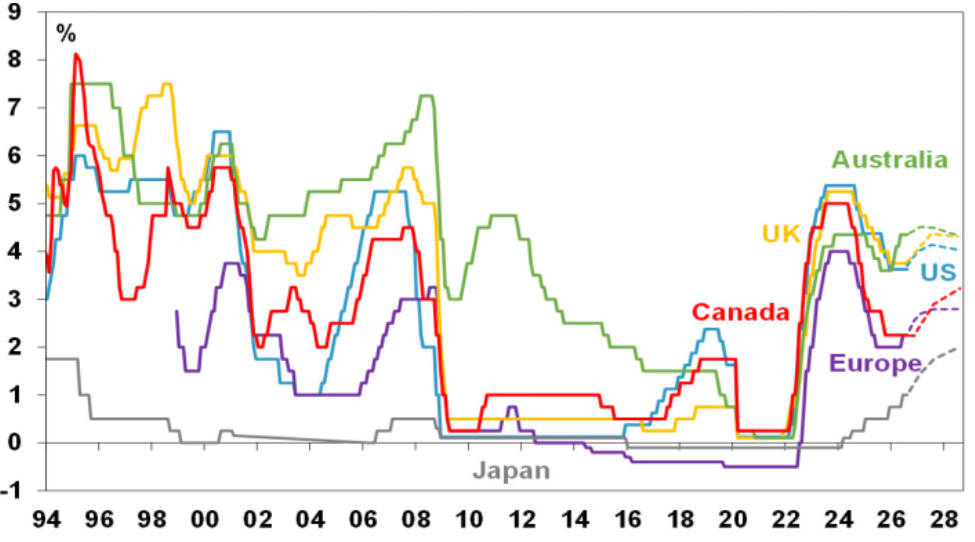
The RBA’s ongoing omission of any reference to cutting the cash rate taken in context with its concerns about inflation indicate that it retains an inclination to raise rates further. The money market is signalling around a 69% probability of another hike in Australia by year end with Australian interest rates expected to remain higher compared to other major countries reflecting higher inflation.
Official Interest rates and implied market pricing
 Source: Bloomberg, AMP
Five reasons to expect a further rise in interest rates
We are continuing to allow for a further rise in interest rates with the next hike likely to come in November as underlying inflation remains too high and will likely take longer to return to target than the RBA is forecasting. Here’s five reasons to expect a further hike.
-
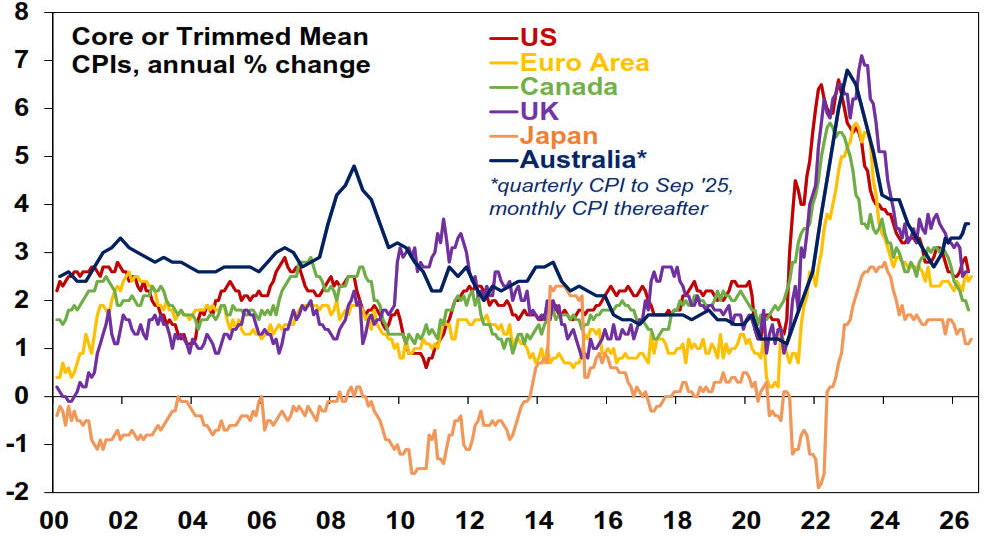
First, underlying or trimmed mean inflation is too high. Its way above target at 3.6%yoy, there is no clear downtrend yet, there are more items in the CPI seeing inflation above 3% than below 2% and inflation is now an outlier on the high side compared to other major developed countries. The latter is important as in the 2022-24 cycle we were with the pack, albeit with a lag, whereas now we have broken higher suggesting something has gone wrong locally.
Global Core Inflation Rates
Source: Bloomberg, AMP
-
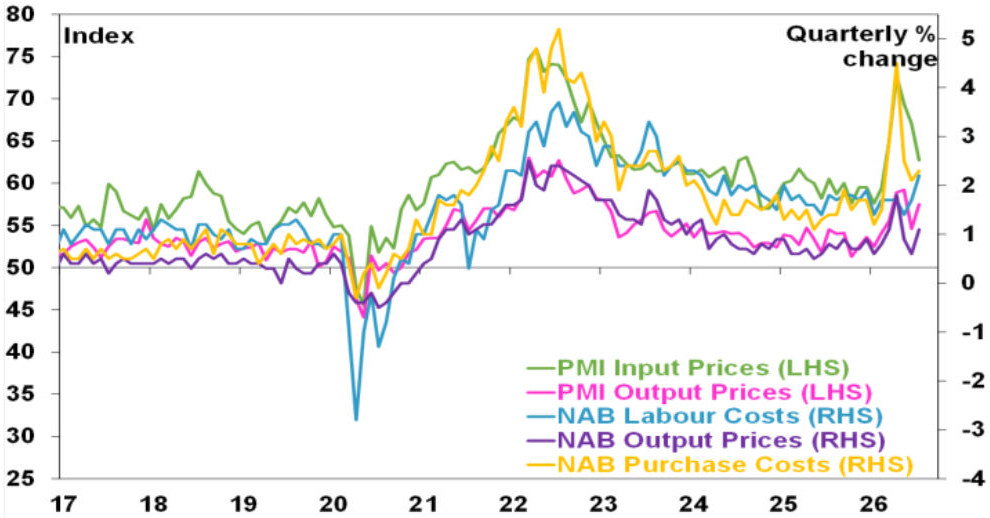
Second, various cost pressures point to higher inflation. The Fair Work Commission’s granting of a 4.75% increase in award wages and 6% increase in the minimum wage point to an acceleration in wages growth, this is unsupported by productivity growth, second round impacts from the oil supply shock are still in the pipeline with oil and petrol prices on the rise again and business surveys still point to elevated cost and price pressures.
Australian Price Surveys
Source: Bloomberg, AMP
-
Third, the credibility of the 2-3% inflation target and the RBA’s commitment to it are increasingly at risk. The combination of bigger government, deglobalisation, decarbonisation, increasing defence spending and aging populations are all making the global and Australian economies more inflation prone and the run of supply shocks starting with the pandemic, the Ukraine War and now the oil supply shock is only adding to this. It could be added to by the AI boom creating increasing demand for key tech products, another El Nino weather pattern and bird flu. Inflation expectations tend to be backward looking, and the longer inflation stays above target – and it now looks like doing so for five of the last six years including the present year – the more people will expect it to stay above target and so for inflation expectations to rise. The longer this continues the less Australians will have faith in the 2-3% target. This will show up in faster wage demands and businesses inclined to put through price rises more regularly. This was less of an issue in relation to the 2022 inflation surge as we had only been above target for a brief period but after years above target the RBA’s credibility is on the line.
-
Fourth, it’s not clear that the economy has slowed enough to rebalance demand with supply and ease capacity constraints. Sure, unemployment is up a bit and house prices are falling but household spending looks solid and business investment is strong (on the back of the data centre boom) and so far, it’s not clear that the house price downturn is anything more than a normal cyclical cooling.
-
Finally, and related to this, public demand remains strong. The Government could have taken pressure off the RBA in the May Budget by cutting spending to free up capacity in the economy and doing more to help boost productivity. Unfortunately, Federal spending is projected to remain around 27% of GDP for the next few years, which is well above pre-pandemic levels and in turn implies that public spending overall will remain around 28% of GDP, which is also well above pre-pandemic levels. There were some good moves to deregulate in the May Budget but these will take years to bear fruit and the tax hike on investors will likely be neutral to slightly negative for productivity.
So, to provide confidence that inflation will come back to target in a reasonable time and that inflation expectations will remain consistent with the target we are continuing to allow for a further rise in rates, with the next hike likely to come in November. The RBA is likely to be in a position to start cutting rates next year, but not until the second half.
But surely there is a better way to cool inflation?
Higher interest rates work to slow inflation in a number of ways but in particular they raise the cost of borrowing which means that existing indebted households and businesses have less left over to spend and new borrowers are discouraged from borrowing. All of which leads to less demand for goods and services in the economy relative to a given level of supply which makes it harder to raise costs and prices. However, this disproportionately impacts households with a mortgage and in that sense is unfair.
The alternative would be for the government to cut its spending and/or raise taxes to help lower private spending, and this would spread the load more fairly. However, governments being run by politicians cannot be relied on to cut spending and raise taxes in times of inflation because its politically unpopular, so after chronic inflation problems in the 1970s and 1980s responsibility for its control was handed to the RBA in Australia. And this is a better outcome than the alternative of risking a return to much higher inflation which disproportionately hits lower income people.
Dr Shane Oliver – Head of Investment Strategy and Chief Economist, AMP
Important note: While every care has been taken in the preparation of this document, AMP Capital Investors Limited (ABN 59 001 777 591, AFSL 232497) and AMP Capital Funds Management Limited (ABN 15 159 557 721, AFSL 426455) make no representations or warranties as to the accuracy or completeness of any statement in it including, without limitation, any forecasts. Past performance is not a reliable indicator of future performance. This document has been prepared for the purpose of providing general information, without taking account of any particular investor’s objectives, financial situation or needs. An investor should, before making any investment decisions, consider the appropriateness of the information in this document, and seek professional advice, having regard to the investor’s objectives, financial situation and needs. This document is solely for the use of the party to whom it is provided.